
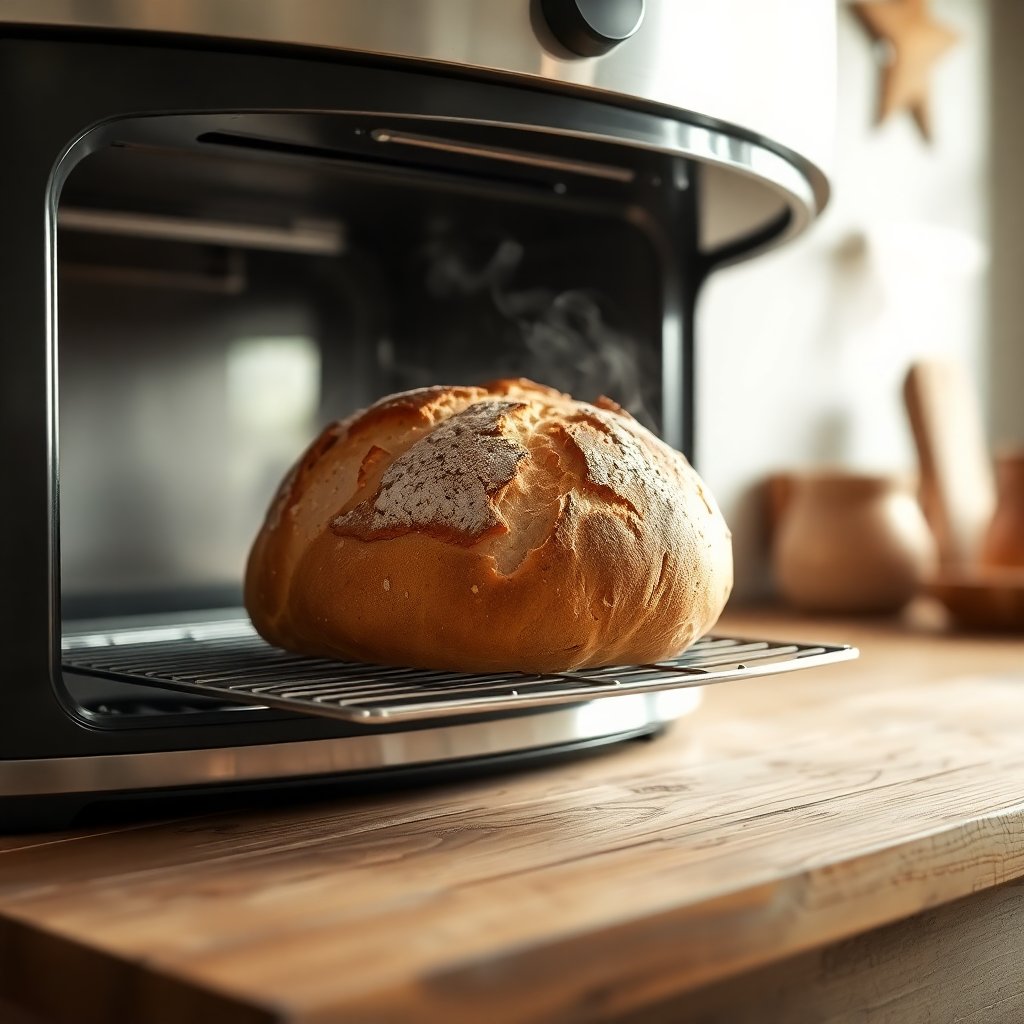
Every sourdough baker eventually hits the same wall. The starter is lively, the bulk ferment looks right, the shaping is tight, and the loaf still comes out of the oven with a dull crust and an ear that never quite opened. Very often the missing ingredient is not in the dough at all. It is steam.
As the holidays approach and bread baking ramps up, the question we hear most from readers who are ready to invest is whether a countertop steam oven is worth the money, or whether a good Dutch oven still does the job. This guide lays out how steam works, what each approach actually delivers, and which one makes sense for the way you bake.
Affiliate disclosure: some links in this post are Amazon affiliate links. If you buy through them we may earn a small commission at no extra cost to you.
Why Steam Matters for Sourdough
For the first several minutes of a bake, a loaf is expanding fast as gas inside the dough heats and the remaining yeast and bacteria have a final burst of activity. That expansion is oven spring. If the surface of the loaf dries and sets too early, it forms a shell that locks the loaf in place.
Steam solves this in two ways:
- It keeps the skin soft and stretchy so the loaf can rise fully and the score can open into an ear.
- It condenses on the cool dough surface, transferring heat quickly and gelatinizing starches on the crust. That gelatinized layer is what later turns glossy, blistered, and crackly.
After roughly the first 15 to 20 minutes, you want the opposite: dry heat to set and brown the crust. Any good steam system needs to do both, steam early and vent late. King Arthur Baking's guide to steam in bread baking covers the science and the classic home-oven methods in more detail.
Option 1: Countertop Combi Steam Oven (Anova Precision Oven 2.0)
Best for: bakers who bake several times a week, want repeatable results, and will use the oven for more than bread.
The Anova Precision Oven is the best-known countertop combi oven in the US. It has a water tank that injects real steam and lets you set relative humidity directly, so you can program a bake that starts at high humidity and drops to dry heat on a timer. The current model is the Precision Oven 2.0, which launched in early 2025 with an MSRP of $1,199; Anova's own listing has shown prices between roughly $999 and $1,299 since then, so check the current price before buying.
What it does well:
- Programmable steam stages. Set a high-humidity stage for the first 15 to 20 minutes, then a dry stage to finish. Every loaf gets the same treatment, which makes it far easier to troubleshoot dough instead of guessing about the oven.
- Temperature stability. Independent testing from RTINGS found its temperature control excellent and rated it well suited to baking.
- Open baking. You can bake directly on a sheet or stone without a lid, which means taller loaves, baguettes, and batards that do not fit in a round Dutch oven.
- Versatility. It also handles roasting, proofing (via low temperature and humidity), reheating bread without drying it, and sous-vide style cooking.
What to weigh before buying:
- Capacity. It fits one standard boule or batard comfortably. If you bake two loaves at once, you will be baking in shifts.
- Max temperature and preheat. Testing has noted slow preheating. Many sourdough recipes call for 475 to 500°F, so check that the oven's maximum and recovery work for your formula.
- Counter space and price. It is large, and it costs more than most full-size ranges' upgrade options. Owners' build-quality reviews are mixed.
- Water maintenance. Descaling is part of ownership, especially with hard water.
→ Shop the Anova Precision Oven on Amazon
Our take: if you bake bread multiple times a week and will also use it as a daily oven, the combi oven is the most controllable home steam setup available. If you bake a weekend loaf, it is a luxury rather than a necessity.
Option 2: Dutch Oven or Combo Cooker
Best for: most home bakers, especially beginners and weekend bakers.
A heavy lidded pot traps the moisture that evaporates from the dough itself, creating a small steam chamber around the loaf. Take the lid off after about 20 minutes and the remaining bake happens in dry heat. It is simple, cheap, and remarkably effective, which is why it became the standard home sourdough method.
A combo cooker (a shallow cast-iron skillet with a deep pot that serves as the lid) is the easiest version: you load the dough onto the shallow side, so there is no reaching into a 500°F pot. We compared specific models in our best Dutch ovens for sourdough guide.
Limits:
- Shape. Round pots suit boules. Long batards need an oval pot.
- One loaf at a time in most home ovens.
- Heavy and hot. Handling preheated cast iron takes care and good mitts.
→ Shop cast iron combo cookers on Amazon
Option 3: Bread Cloche or Bread Pan
Best for: bakers who want Dutch-oven results with better shape options or less weight.
Ceramic cloches and purpose-built bread pans work on the same principle as a Dutch oven but are designed specifically for bread. Some, like the Challenger Bread Pan, are rectangular cast-iron pans that take long batards. Unglazed ceramic cloches absorb a little water if soaked or misted, adding extra steam at the start. Enamelled steel or lighter cast-aluminum versions are easier on the wrists.
→ Shop bread cloches and bread pans on Amazon
Option 4: DIY Steam in a Regular Oven
Best for: baguettes, multiple loaves at once, and bakers who already own a baking stone or steel.
Open baking on a stone or steel with added steam is how most serious home bakers make baguettes and bake two loaves at once. The common methods:
- Preheated cast-iron pan plus boiling water or ice. Place a heavy pan on the lowest rack, pour in a cup of boiling water as you load the bread, and close the door fast. Protect the oven glass with a towel while pouring.
- Lava rocks or steel chains in a pan add surface area so the water flashes to steam faster and more completely.
- A covered hotel pan or an inverted roasting pan over the loaves on the stone to trap their own moisture.
Wear long sleeves and stand back when the steam hits; a burst of steam burns faster than a hot pan. Gas ovens are the big exception: they vent combustion gases constantly, and King Arthur's bakers note that added steam escapes almost immediately, so in a gas oven a covered baker such as a Dutch oven or cloche usually beats an open water pan. A pan of tightly rolled, boiling-water-soaked kitchen towels is another trick that keeps steam going for the first 20 minutes or so.
For choosing the surface under your bread, see our comparison of baking stones vs baking steels.
→ Shop lava rocks and steam pans for bread on Amazon
Option 5: Full-Size Ranges and Wall Ovens with Steam
Several appliance makers sell full-size wall ovens and ranges with steam-assist or full combi steam modes. If you are already remodeling a kitchen, a steam wall oven gives you the Anova's control plus the capacity for two or more loaves. Capabilities vary a lot between models; some "steam clean" or "steam assist" features add only a small burst of moisture, so read the spec sheet for adjustable humidity before paying the premium for bread baking.
Comparison at a Glance
| Method | Upfront cost | Control | Loaves per bake | Shapes | Learning curve | |---|---|---|---|---|---| | Combi steam oven | High | Excellent, programmable | 1 | Any that fit | Low | | Dutch oven / combo cooker | Low to mid | Good, passive | 1 | Round or oval | Low | | Cloche / bread pan | Low to mid | Good, passive | 1 | Pan-dependent | Low | | DIY steam + stone | Low | Variable | 2 or more | Any, incl. baguettes | Moderate | | Steam wall oven | Very high | Excellent | 2 or more | Any | Low |
How to Tell Whether Steam Is Your Problem
Before you buy a $1,000 oven, confirm steam is the bottleneck:
- Dull, matte, pale crust even with good browning time points to too little steam.
- Ear that never lifts, score that seals over often means the crust set too early.
- A burst or torn side with a tight score can mean steam vented too early or the score was too shallow. Review our guide to scoring sourdough before blaming the oven.
- Dense, gummy crumb is usually fermentation or shaping, not steam. Fix that first.
If a Dutch oven already gives you a glossy, blistered loaf with a good ear, a steam oven will make results more consistent and more versatile, not dramatically better.
Our Recommendations
- Most bakers: a cast-iron combo cooker. It is the best value in bread equipment and nearly impossible to outgrow for boules.
- Batard and baguette lovers on a budget: a baking steel plus a lava-rock steam pan, or a rectangular bread pan.
- High-frequency bakers who want precision and a second oven: the Anova Precision Oven 2.0, ideally bought during a sale and with the understanding that it is a one-loaf-at-a-time machine.
- Remodelers: a true combi steam wall oven with adjustable humidity.
Whatever setup you choose, the principle stays the same: humid heat while the loaf rises, dry heat once it has set. Get that right and the crust takes care of itself.
As an Amazon Associate we earn from qualifying purchases. This article contains affiliate links; if you buy through them we may earn a small commission at no additional cost to you.